Active Warrants affect daily life when a name surfaces in a statewide lookup, prompting urgent questions about legal standing and safety. A precise warrant search by name can reveal bench warrants, failure‑to‑appear notices, or misdemeanor and felony classifications. Understanding how the warrant database updates, what sealed records look like, and why some outstanding warrant records may lag helps users decide the next step—whether to verify status with court clerks or seek legal counsel.
Active Warrants often appear in background checks, employment screens, and housing applications, making the warrant status a critical piece of personal data. An effective active warrant lookup by name or case number uncovers the current warrant record, highlights any misidentifications, and guides the individual toward proper surrender procedures. Knowing how to interpret warrant information and where to find reliable public warrant records can prevent surprise encounters with law enforcement.
How to Search Active Warrants
An active warrant is a current court order that gives police authority to arrest the person named in the order. In addition, consulting official kane county records confirms that the Illinois State Police active warrant search checks Illinois warrant records by name or warrant number and can return the name, warrant number, warrant type, issuing county, and agency shown on each record. Its main purpose is to point the searcher to the court and sheriff offices needed to verify status. A search result is a starting point, not a replacement for the court file.
Official Search Portal: https://www.ispillinois.gov/PublicSafety/WarrantSearch
Steps to Search
- Open the Illinois State Police Active Warrant Search page at the official portal listed above.
- Enter the person’s full legal name as it appears on court papers. If the form asks for a date of birth, add it to reduce common-name matches. Use the warrant-number field when you have that number.
- Submit the search and review every match. Do not stop at the first name, since a common name can produce more than one person or record.
- Write down the exact identifiers, court, county, and agency for each possible match. Note any return date, appearance date, or surrender instruction shown on the result or related notice.
- Confirm the result with the circuit court clerk for the case and the sheriff named in the record. If court action is required, follow the confirmed instructions or obtain advice from a licensed attorney before responding.
How to Read Active Warrant Record Details
Search pages and related court notices can contain several identifiers and labels. Each field answers a different question, and a record should be matched using more than one detail. The table below explains common fields and the best source for confirming them.
A warrant number and a case number serve different purposes, yet both can help locate the correct record. The warrant number points to the order, while the case number points to the court case that may include appearances, bond, charges, and later orders. A missing field should not be filled with a guess. The issuing court can match the person’s records even when a search form contains only a name.
Classifications of Active Warrants
Warrant searches often mix different record labels. A person may have a court case, a failure-to-appear notice, and a warrant entry at the same time, or the labels may describe separate stages of one event. Each entry should be read as a snapshot and checked against the legal document behind it.
Bench Warrants and Failure-to-Appear Notices
A bench warrant is a judge-issued order used when a person does not meet a court requirement. A missed required appearance is one common reason, and failure to follow another court condition can also lead to one. Once entered, the order can permit arrest until the court recalls, quashes, or otherwise closes it.
A failure-to-appear notice, or FTA notice, reports a missed court date. It may come before a bench warrant, explain why one was requested, or state that a warrant has already issued. The wording matters. A notice with a new hearing date may not itself be an active warrant, so ask the clerk whether the court entered a warrant. Neither an FTA notice nor a warrant entry is a conviction or proof that the person committed the alleged offense.
Misdemeanor and Felony Warrant Classifications
Misdemeanor and felony labels describe the type of case connected to the warrant. They do not show whether officers have served the warrant, whether a bond has been posted, or which appearance date controls. The charging court’s record provides the proper source for those facts.
Details Needed for an Active Warrant Lookup
A name-only lookup can produce too many matches or miss a record filed under a legal name that differs from a nickname. Gathering the identifiers below makes an active warrant records check more precise and gives the court clerk a way to locate the correct file.
- The full legal name, including any middle name, suffix, or alias shown on court papers.
- The date of birth.
- The circuit court case number, if known.
- The warrant number printed on a notice, charge sheet, or other court document.
- The issuing court, county, and sheriff or police agency.
- The appearance, return, or surrender deadline printed on the notice.
- A copy of the FTA notice, email, letter, or other document that led to the search.
Keep the source document with the identifiers. A private search result can help locate a case, but the issuing court and sheriff control the legal status and the official record. If a notice lists a court in one county and a sheriff in another, give both offices the case and warrant numbers. That gives each office the full path to the same case.
Steps to Take Regarding an Active Warrant
A result should lead to prompt verification and a lawful response. The right next step depends on whether the entry is an active warrant, an FTA notice, a recalled warrant, or another person with the same name. Use the collected identifiers before contacting a court, sheriff, or attorney.
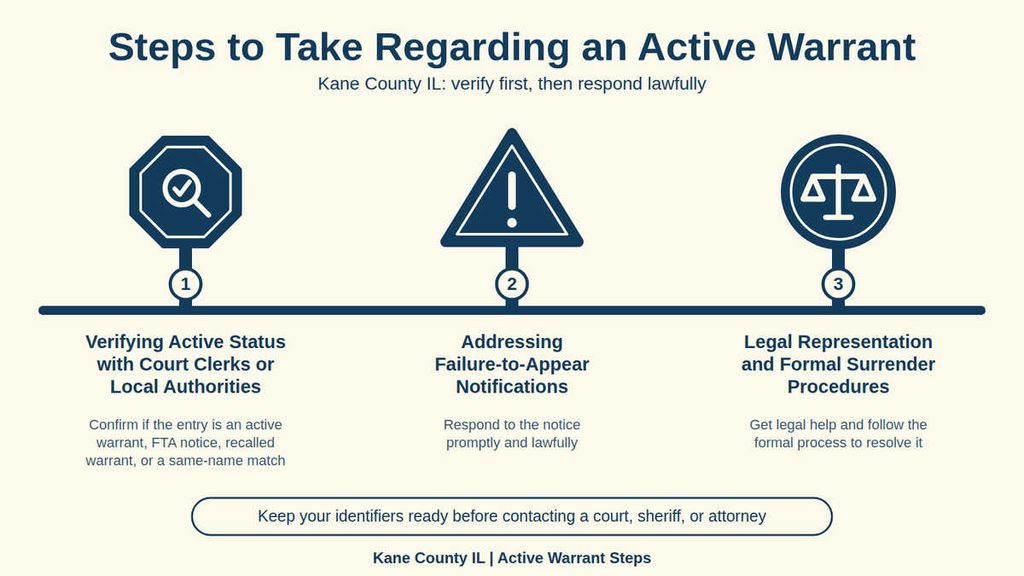
Verifying Active Status with Court Clerks or Local Authorities
The circuit court clerk for the county named in the record is the main source for docket status. Ask whether a warrant was entered, the date it was entered, whether it has been recalled or quashed, and whether there is a scheduled appearance or bond condition. A clerk may provide a case reference number or direct the request to the judge’s office if the entry is restricted.
The sheriff’s office can confirm whether it received, served, or is seeking to execute the warrant. A sheriff does not decide the guilt of the accused person, but the office may know the current service status. If a result names a county other than the person’s home county, use that county’s clerk and sheriff rather than a local office that has no case file.
Ask each office for the date and reference number connected with its response. A written or system-based confirmation gives the person a clear record of what the office reported. If the clerk and public portal conflict, ask the issuing court to compare its order with the sheriff’s service record and correct any outdated entry.
Addressing Failure-to-Appear Notifications
An FTA notice should be treated as a deadline, not as a routine letter. Contact the court before the return date if the notice allows that, or as soon as possible if the date has passed. Ask what the court will accept as a response and whether a new hearing date has been set.
Missing another date after receiving an FTA notice can lead to a bench warrant and added case consequences. Do not assume the notice is resolved because an attorney, family member, or private lookup service was contacted. The court must record the response, and the clerk can check whether a warrant has been entered. Keep the case number and written confirmation of any new date.
Legal Representation and Formal Surrender Procedures
A licensed Illinois criminal defense attorney can review the charge, warrant affidavit, bond, release conditions, and current court status. The attorney can also advise on a request to recall or quash a warrant when the legal record supports it. Advice from counsel does not cancel a warrant by itself, and a person should not miss a hearing while waiting for a request to be decided.
People who cannot retain counsel can ask the court about its appointed-counsel process. Eligibility and availability depend on the charge, the court’s rules, and local procedures, so no one should assume that free counsel is available. The clerk can explain how to request a decision without giving legal advice about the charge.
Record Accuracy and Resolution
An active warrant lookup depends on records created by courts and agencies, so search results can be right about one database and wrong about another at the same moment. To assist researchers, official warrant records documentation shows that the main issue may be a delayed update, a name mismatch, a restricted record, or a different case number. Resolve the conflict with the issuing court and sheriff rather than through repeated searches alone.
Processing Delays for Recently Issued or Cleared Warrants
A warrant may pass through multiple records: a court order, a clerk’s entry, a sheriff’s service file, and a statewide search entry. Each step depends on submission and processing. A recently issued warrant can be absent from the public page, and a recalled, quashed, served, or expired warrant can remain visible after the legal event. There is no dependable public waiting period that applies to every case.
For that reason, treat each search result as a snapshot rather than a live order. If the result says active, confirm the date and status with both the clerk and sheriff. If a result appears after a recall or quash, report the stale entry and request a status update. A no-hit result can also reflect a delay, so it does not prove that no active warrant exists.
Recalled, Quashed, Served, and Expired Warrants
A recalled warrant has been withdrawn under a court order, often while the court keeps the underlying case open. A quashed warrant has been voided or canceled after the appropriate legal action. A served warrant has been executed by police, which does not mean that every other matter in the case has ended. A warrant may expire under its terms or applicable law, so the date and legal basis need confirmation.
These terms can remain on an older screen after the court acts. A recall or quash order also cannot cancel a different warrant entered later. Ask for the current status of the exact warrant number and check for related cases before treating any status label as settled.
Sealed, Confidential, or Restricted Law Enforcement Records
Sealed, confidential, or restricted records are not available for public viewing in many situations. A judge can seal a case, and Illinois law can limit access after an expungement or other court action. A sealed warrant may never appear in a public search. A restricted police file may also stay outside the statewide search.
Ask the court clerk whether a public index entry exists. The clerk may be unable to describe a sealed case, and a lawyer may need to ask the court for permission to review it. The absence of a public result cannot confirm that a case was dismissed, recalled, or never issued. Sites that promise to reveal sealed records through a paid search should be treated with care because the public portal cannot provide what the court has sealed.
Resolving Misidentifications and Missing Records
Common names, aliases, changed addresses, and typing errors can create false matches or hide a real one. The person should never assume that every record under the same name belongs to them. If the search shows a different birth date, address, or middle name, pause and verify with the issuing court before taking any legal step.
When correcting a record, provide a copy of the notice or another court document that supports the requested change. Ask the clerk or sheriff to document the correction and confirm the updated status. Keep a record of who handled the request, the date, and the reference number. Repeating a search under many spellings can create more results without fixing the source data.
Active Warrants Across Jurisdictions and Background Checks
A verified active warrant does not stop having force because a person moves, changes jobs, or leaves Illinois. The person must treat the record as a legal issue wherever the person lives. Public screening systems and police systems can show different views of that record because they receive data on different schedules.
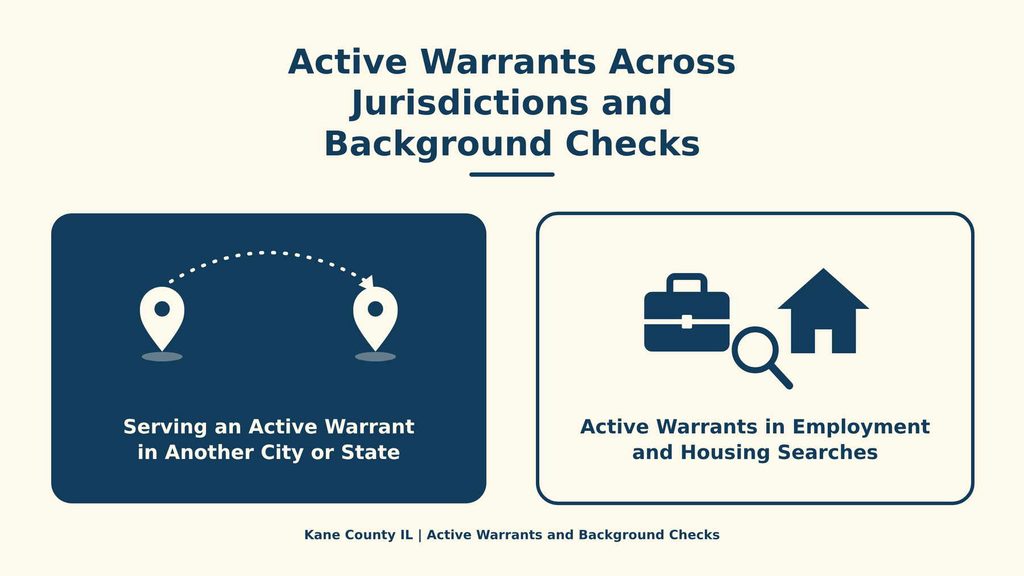
Serving an Active Warrant in Another City or State
A warrant issued in one county can lead to arrest in another city, county, or state. Police where the person is found may receive a wanted notice, take custody, and contact the issuing court. The exact procedure depends on state law and the agencies involved. A lawyer or the issuing court can address pending appearance or surrender duties before travel. No person should assume that an Illinois search covers every U.S. jurisdiction or that moving away cancels the case.
The Illinois State Police portal covers Illinois active warrant records. A record from another state or a U.S. government agency must be checked through that agency’s own process. If more than one state or agency may be involved, give each authority the relevant case number and ask which court controls each matter. This prevents a search in one system from being mistaken for a full nationwide check.
Active Warrants in Employment and Housing Searches
Public active warrant data can appear in some employment, housing, tenant, licensing, and other background-screening products. Each provider chooses its sources, refresh schedule, and matching rules, so one report may differ from another. A name match can involve the wrong person, an old entry, or a case with a new status. The record number, source agency, and report date should be checked before acting on the match.
A screening hit is a reason to request the source record, not proof of the reported facts. The person can ask the provider for the source agency, case reference, date accessed, and correction process, then confirm with the court. Employers, landlords, and licensing bodies must follow the laws and rules that apply to their own use of the report. A public record’s presence does not predict the outcome of any application or inquiry.
Contact Information
Use these official Kane County Sheriff’s Office details to reach the office or its non-emergency dispatch line for a Kane County record. Staff may direct callers to the appropriate department for general record inquiries. A warrant filed elsewhere belongs with the court clerk and sheriff listed in that record. Provide relevant details, such as a case number or record date, when requesting assistance. Contact the responsible agency directly to confirm current information and available records.
Frequently Asked Questions
Active warrants are court orders that allow law enforcement to take a person into custody. Knowing how to locate an active warrant, check its status, and understand the next steps can prevent surprise arrests and help resolve legal matters quickly. State and county databases, including the Illinois State Police system, let the public look up warrant information by name, case number, or warrant number. These tools give the name, type of warrant, issuing agency, and sometimes the bond amount. Use the information to contact the proper sheriff office, such as the Kane County Sheriff’s Office at 630‑232‑6840, before any enforcement action occurs.
How can I perform an active warrant search by name?
Visit the Illinois State Police online portal or the local sheriff’s website. Enter the full legal name in the search field and submit. The system returns any active warrant records, showing the warrant number, issuing county, and type of charge. Review the details, then call the listed agency—like Kane County Sheriff’s Office at 630‑232‑6840—to confirm the status and learn any required steps to resolve the warrant.
What information does an active warrant lookup provide?
The lookup shows the individual’s name, warrant number, date issued, issuing court, and the agency responsible for execution. It may also list the bond amount and any scheduled court dates. This snapshot helps you verify whether the warrant is still active, understand the seriousness of the charge, and plan contact with the appropriate law‑enforcement office.
Can I search for an outstanding warrant using a case or warrant number?
Yes. On the state or county database, select the “search by case number” or “search by warrant number” option. Input the exact number and run the query. The result displays the warrant’s current status, the charge description, and the agency holding the record. If the warrant is active, the page typically includes a phone number for the sheriff’s office, allowing you to discuss resolution options directly.
How do I find active warrant records for Kane County?
Go to the Kane County Sheriff’s Office website or call the main line at 630‑232‑6840. Use the online warrant lookup tool, entering the name or warrant number. The system pulls any active warrants filed in Kane County, showing the issuing court, bond details, and contact information for the arresting agency. If the online tool is unavailable, the dispatcher at 630‑232‑8400 can confirm the record over the phone.
What steps should I take if I discover I have an active warrant?
First, contact the agency listed on the warrant record to verify the details. Ask about bond options, court dates, and any required paperwork. If possible, arrange a voluntary surrender at the designated location to avoid surprise arrests. Keep a written record of all communications and follow any instructions given by the sheriff’s office or court clerk to clear the warrant as quickly as possible.